Gnaoua and World Music Festival of Essaouira: The Complete 2026 Guide
Program, stages, artists, tickets, accommodation and practical tips: everything you need to experience the Gnaoua and World Music Festival of Essaouira 2026, from June 25 to 27.
Gnaoua and World Music Festival of Essaouira: The Complete 2026 Guide
The Gnaoua and World Music Festival of Essaouira has become one of the biggest cultural gatherings in Morocco. Over the years, it has grown from a local celebration of tagnaouite into a large international musical laboratory, without ever losing its grounding in the art of the maâlems. To understand its recent trajectory, these few markers say it all:
- 2022: special touring edition across four Moroccan cities after the pandemic interruption
- 2023: return to the usual format in Essaouira
- 2024: 25th edition, launch of Berklee at Gnaoua
- 2025: 26th edition, 54 concerts, more than 300,000 festival-goers, rising profile of the UM6P Chair
- 2026: 27th edition, the "port cities" thread and a Forum on the world's youth
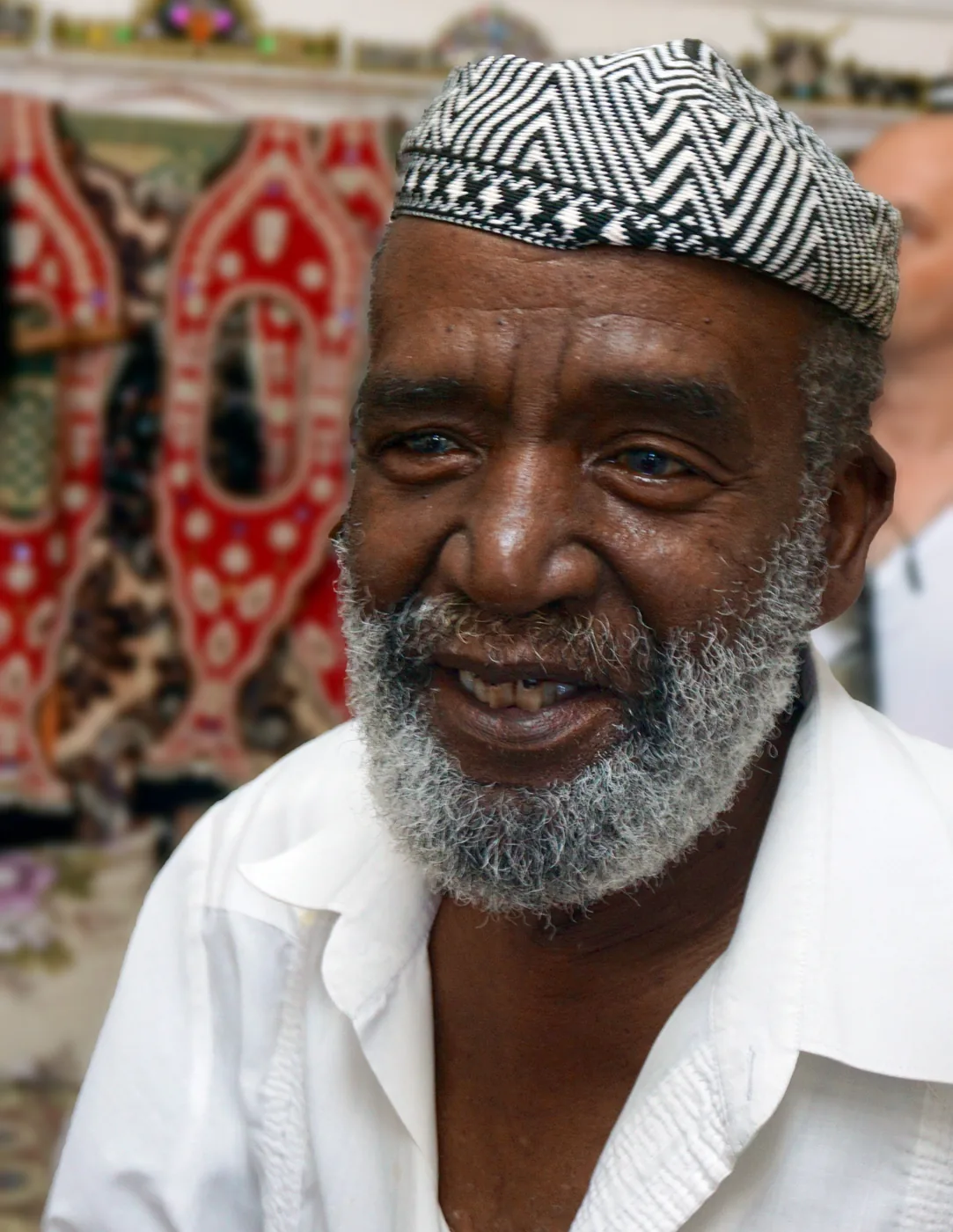
Gnaoua musician performing traditional music.
Fundamentally, the festival has changed scale without losing its core. It remains anchored in the art of the maâlems, but it sets that art within a much wider space made of debates, research, artistic residencies and transmission. The creation of the "Berklee at the Gnaoua and World Music Festival" program in 2024, its renewal in 2025 and 2026, and the activation of the UM6P Chair around cultural crossovers, all show that the festival's ambition now extends far beyond the concerts alone.
Program, stages and genres
The festival's matrix is fairly stable from one year to the next. It usually begins with an opening parade of the maâlems through the city, then shifts to a grand inaugural concert on the Moulay Hassan stage. Around this spectacular core, the festival deploys large stages, intimate concerts, a Human Rights Forum, the "Arbre à palabres" (talking tree), "off" events throughout the city and, since 2024, an international training program with Berklee. In 2026, the opening is set to be led by Mehdi Nassouli with the Rwandan group i Buhoro, Moroccan singer Sara Moullablad, vocalist ganavya and French musician Sylvain Barou, in a creation conceived as a dialogue between living heritages.
The 2026 edition also confirms a particularly legible thread: port cities and cultural circulations. The organization explicitly links this year's programming to territories shaped by movement, from Beirut to Bahia, from Ethiopia to Morocco, from Palestine to Cameroon. This thematic frame illuminates the festival's artistic policy very well: Gnaoua is not presented as a closed folklore, but as a language of crossing, memory and transformation.
In terms of genres, expect a very wide aesthetic range. The 2025 and 2026 press materials announce crossovers with spiritual jazz, afrobeat, reggae, Afro-Cuban music, alternative Arab scenes, Amazigh traditions, gospel, the electrified dabke of 47SOUL, and more experimental forms. This diversity is not marketing window-dressing: the festival describes it as the direct consequence of its "tradition of fusion," its true signature.
The schedule follows a now fairly clear logic: forum in the morning, conversations and thinking formats in the afternoon, "off" events in the city in the late afternoon, then large stages and intimate concerts from the evening until after midnight. In 2024, the official program showed, for example, a Forum from 10 a.m. to 1 p.m., an Arbre à palabres from 4 p.m. to 6 p.m., "off" events from 5:30 p.m., then large stages from 7 p.m. or 8 p.m. In 2025, the official grid showed a Forum from 9 a.m. to 1:30 p.m., the Arbre à palabres from 4 p.m. to 6 p.m., "off" events at 5:30 p.m. and concerts running until 12:50 a.m. In 2026, the official program again announces final sets past midnight.
A useful map of the venues
| Space | Identified venues | Most likely use |
|---|---|---|
| Large stages | Place Moulay Hassan, beach stage, Borj Bab Marrakech | Headliners, fusions, large evening concerts |
| Intimate concerts | Dar Souiri, Bayt Dakira, Zaouia Issaoua, Zaouia Sidna Blal, former Danish Consulate | Tighter formats, often tied to attentive listening and proximity |
| Ideas programs | Atlas Essaouira Riad Resort, Institut Français d'Essaouira | Human Rights Forum, panel discussions, Arbre à palabres |
| The city as a stage | Sqala, Place de l'Horloge, Place El Khaima | "Off" events in the city, brass bands, guest troupes and urban activations |
Beyond the official program, the festival also offers "Afters" in certain emblematic venues before and after the main concerts. If you are planning a piece focused on the nightlife and immersion angle, this is worth flagging, while noting that the exact details vary from one edition to the next.
Artists, lineages and the festival's signatures
To understand the reputation of the Gnaoua Festival, you have to look at both the "global" guests and the Gnaoua lineages that structure it. The official 2024 dossier recalls earlier encounters that have become almost mythical: Jimmy Page and Robert Plant with Maâlem Brahim El Belkani, Randy Weston with Maâlem Abdellah El Gourd, or Carlos Santana with Maâlem Mahmoud Guinea. The festival's founding idea was already there: to make Essaouira a place where Moroccan musical history is written in the encounter with other sound worlds.
Among the recurring figures, Hamid El Kasri is probably one of the most central. The official website describes him as one of the festival's pillars and recalls that his 2004 fusion with Joe Zawinul marked the event's history. Abdeslam Alikkane holds another essential place: artistic director of the festival, a founding figure and president of the Yerma Gnaoua association, he embodies the link between the stage, transmission and the cultural recognition of the Gnaoua repertoire.
The trajectory of Mustapha Baqbou also sums up the festival's philosophy well. The official dossier presents him as one of the major pioneers of Gnaoua fusion, with past collaborations alongside Marcus Miller, Pat Metheny, Louis Bertignac, Éric Legnini and Sixun. In a festival often described as a "musical laboratory," Baqbou embodies the generation that made the very idea of dialogue between tagnaouite and international scenes possible. The collective tribute planned for 2026, following his passing in 2025, gives this memory a particular weight.
You should also follow the artists who are renewing the festival's narrative. Asmaa Hamzaoui and Bnat Timbouktou hold an emblematic place because they open up a historically male universe, while remaining fully rooted in the codes of the tradition. The official 2024 dossier also recalls her striking fusion with Les Amazones d'Afrique during the 24th edition, while 2025 paired her with Rokia Koné in a gesture explicitly built around memory and powerful female voices.
For 2026, several names immediately set the tone of the edition: Carlinhos Brown, Richard Bona, Asma Lmnawar, Yasmine Hamdan, 47SOUL, ganavya, Harlem Spirit of Gospel by Anthony Morgan, Oudaden, Hoba Hoba Spirit, Bob Maghrib and Bnat Louz & Raskas. It is a lineup that is both very legible and very coherent: Africa, the Mediterranean, the diaspora, port cities, oral traditions, grooves, spiritualities and urban scenes all meet without canceling each other out.
The last five editions
| Year | Dates | Format | Highlights |
|---|---|---|---|
| 2022 | June 3–24, 2022 | Special touring edition | Post-pandemic return as a tour passing through Essaouira, Marrakech, Casablanca and Rabat, instead of a single base in Essaouira. |
| 2023 | June 22–24, 2023 | Return to the usual format in Essaouira | Resumption of the "classic" formula after the interruption and the 2022 tour; around forty concerts spread across Moulay Hassan, the beach, the Borj and intimate evenings; forum and jam/fusions highlighted. |
| 2024 | June 27–29, 2024 | 25th anniversary edition | More than 400 artists and 53 concerts; launch of "Berklee at Gnaoua"; Forum on Morocco–Spain–Portugal relations; anniversary lineup with Buika, The Brecker Brothers Band Reunion, Saint Levant, Bokanté, Labess, Aïta Mon Amour, etc. |
| 2025 | June 19–21, 2025 | 26th edition | 350 artists, 40 maâlems and 54 concerts; more than 300,000 festival-goers; Forum on human mobility and cultural dynamics; second Berklee edition; first public panels of the UM6P Chair; major highlights with CKay, Cimafunk, Tiken Jah Fakoly, Dhafer Youssef, Rokia Koné, Marcus Gilmore. |
| 2026 | June 25–27, 2026 | 27th edition | Around 460 artists; the "port cities" thread; Forum on "Youth of the world: freedom, identity, future"; opening creation with Mehdi Nassouli; return of Carlinhos Brown; Richard Bona with Asma Lmnawar; tribute to Mustapha Baqbou; 42 maâlems announced across the edition. |
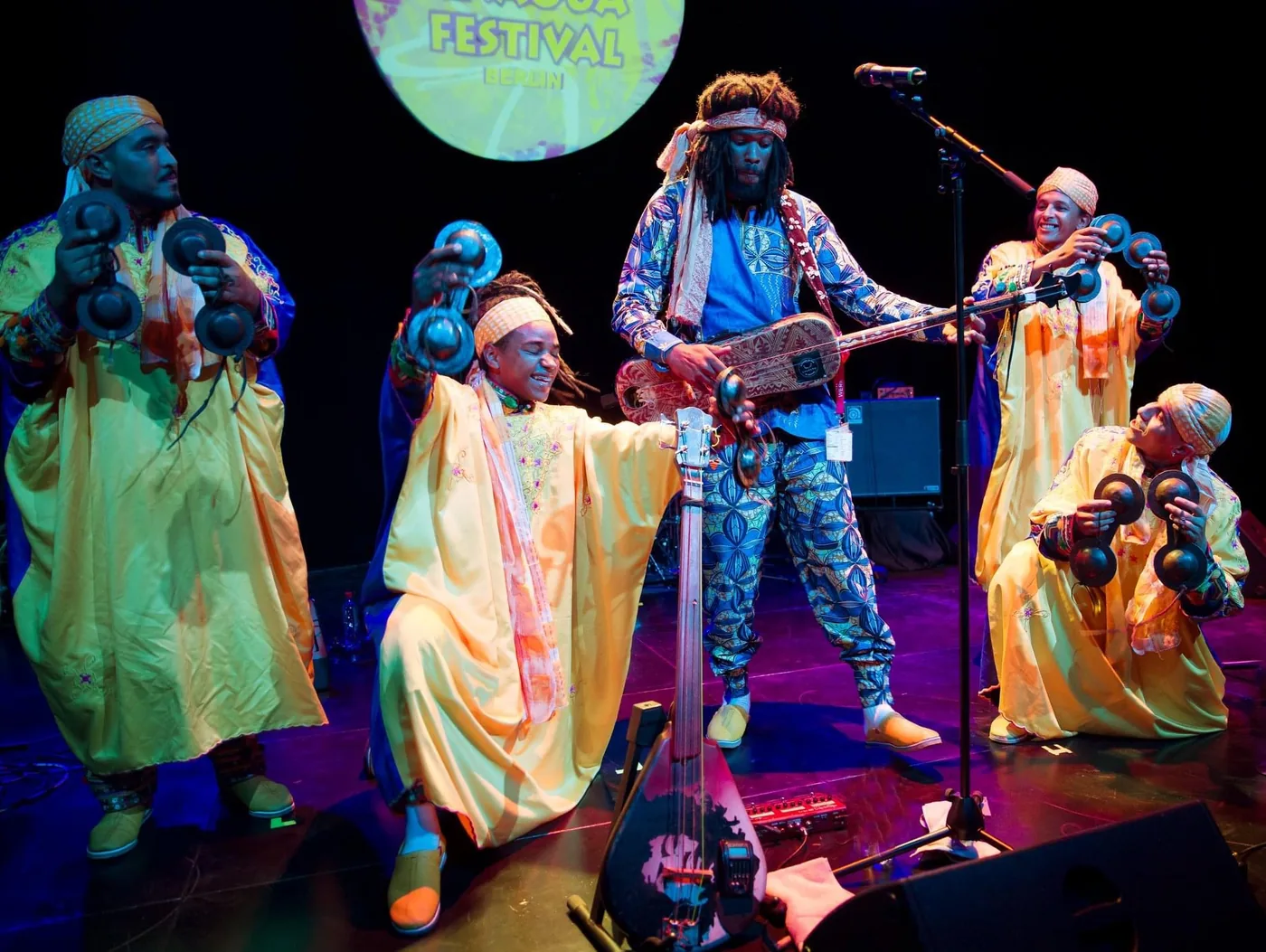
Gnaoua artist performing on stage.
Planning your stay
Tickets and price range
For 2026, the officially published price range runs from 250 MAD per evening for several intimate concerts to 1,200 MAD for the 3-day pass to the Moulay Hassan stage. Ticketing distinguishes access by space: Moulay Hassan, the beach, Borj Bab Marrakech and the intimate concerts. The most important thing to understand is that the official published prices cover access to the corresponding zones — in particular the areas in front of the stage and the intimate formats — and that the page alone does not fully detail every possible movement outside of these spaces.
| 2026 access | Official price | Useful detail |
|---|---|---|
| 3-day Moulay Hassan pass | 1,200 MAD | Large format, access to the corresponding area in front of the stage |
| Moulay Hassan ticket, Thursday | 400 MAD | Opening night |
| Moulay Hassan ticket, Friday | 600 MAD | Major evening |
| Moulay Hassan ticket, Saturday | 600 MAD | Final major evening |
| 2-day beach pass | 500 MAD | Beach stage over two days |
| Beach ticket, Friday / Saturday | 300 MAD | Daily access |
| Borj ticket, Friday / Saturday | 300 MAD | Separate space reserved for this access |
| Intimate concerts | 250 MAD / evening | Dar Souiri, Bayt Dakira, Zaouias, former Danish Consulate; some tickets sold only at the official shop |
The logistical point not to miss is this: passes bought online must be exchanged for a badge and a wristband, handed out at the Moulay Hassan parking lot, while e-tickets are usable directly. For 2026, the official website indicates pickup from 11 a.m. to 11 p.m. It also specifies that unaccompanied children under 12 are not admitted to the area in front of the stage, and that under-12s are not admitted to the intimate evenings.
Getting to Essaouira
The logic of getting to Essaouira is simple: road or air. The festival's practical pages direct visitors toward air and road access to Essaouira, while the Moroccan National Tourist Office notes that from a Moroccan airport you will find taxi, shuttle or car rental, and that intercity travel within the country goes by taxi, bus, train or rental car depending on the combinations you choose. In short, for a festival trip, the smoothest scenarios are either a direct flight to Essaouira-Mogador when one exists, or an arrival via Marrakech or Casablanca followed by a road journey.
Essaouira itself lends itself well to a stay centered on the medina, the seafront and the festival spaces. The tourism office describes the city as the "Bride of the Atlantic," with crenellated ramparts, a listed medina and a strong artistic identity; this matters because the festival's layout takes full advantage of this heritage topography.
Where to stay
For a successful stay, the best advice is not to draw up an endless list of hotels, but to offer logics of choice. If the goal is to be as close as possible to the large stages and the "off" events, the medina and its immediate surroundings are the best base. If you prefer more space or a more direct relationship with the seafront and certain partner venues, the beach / hotel axis may be more practical. On the 2026 site, the visible partners include Heure Bleue and MGallery, while the Atlas Essaouira Riad Resort appears as the forum venue in several recent programs. With an event that exceeded 300,000 visitors in 2025, booking ahead remains a reasonable precaution.
Accessibility, safety and the best time to come
On accessibility, the honest point is to say what is confirmed and what is not. The official pages consulted give the venues, prices and programs, but as of June 15, 2026 they do not detail a unified reduced-mobility setup for all the stages. Since the festival spreads between large stages, the medina and more intimate heritage venues, it is better to ask the organization for written confirmation before booking accommodation or a pass if accessibility is a decisive issue.
On safety, you should stay concrete and not alarmist. Official French and British advice recommends ordinary vigilance in Morocco: avoid quiet areas after nightfall, do not display valuables, limit the cash you carry, and stay alert in tourist areas, medinas and on beaches, where petty crime exists. In the context of a very dense festival, this mainly means managing your personal belongings, agreeing on a group meeting point and favoring accompanied returns after the last concerts.
The best time to come depends on the purpose of the trip. If the goal is the festival, you should arrive at the latest on the morning of the first day so you don't miss the parade and the opening; if the goal is to combine the festival with a quieter exploration of the city, ideally add a day before or after. Recent programs show that the festival's real tempo begins in the late afternoon and stretches well past midnight, which makes leaving the next morning much more comfortable than leaving immediately after the final evening.
Photographers, journalists and local etiquette
For photographers and journalists, two official pieces of information matter immediately. First, as of June 15, 2026, press accreditation requests for the 27th edition are listed as closed on the official website. Second, the same page recalls that journalists, photographers, content creators and other media professionals must go through an online form and wait to be contacted by the press team when an accreditation campaign is open. The editorial takeaway: for a future edition, apply early.
The ticketing site adds a fundamental rule for images: it is strictly forbidden to take photos or videos at the intimate evenings. This detail is worth remembering, because it is one of the points where usual festival habits do not automatically apply in Essaouira.
At the same time, the official website recalls that the public may be photographed and filmed by accredited media and the festival's official teams. For a journalist, this means the scene is tightly framed in media terms; for an independent photographer, it means adopting a flexible, respectful and non-intrusive method, especially in the heritage spaces and proximity formats. In 2025, the festival counted 250 journalists and media teams from 120 outlets, which shows how much access to the scene and the quality of placement also come down to anticipation.
Good local etiquette comes down to a few rules, but they count. Avoid treating the Gnaoua sequences as a simple "exotic" show, remember that behind them lies a ritual and therapeutic imaginary recognized by UNESCO, ask permission before close portraits when the context calls for it, and adopt dress and behavior respectful of local customs, as travel advisories recommend. The festival is open, cosmopolitan and visually generous; that does not cancel out its symbolic depth.
Suggested itinerary, FAQ and practical tips
Suggested three-day itinerary
| Day | Morning | Afternoon | Evening | Why it works |
|---|---|---|---|---|
| Day 1 | Arrival, settling in, scouting the medina / ramparts | Opening parade and first "off" scouting | Grand opening concert then Moulay Hassan | You enter the festival's narrative through its most emblematic collective gesture: the city in motion, then the shock of the opening |
| Day 2 | Human Rights Forum | Arbre à palabres, a photo break in the medina, a pass through the "off" events | Chain together the beach, the Borj or a large stage depending on the evening you target | This is the most balanced day between ideas, the city and concerts |
| Day 3 | Final forum morning or a heritage visit | A quieter walk, craft shopping, a last "off" | Finale on the priority stage then an after if announced | You enjoy both the festival and Essaouira without getting stuck in a single stage logic |
Two-day variation
If you only have two days, aim instead for the two evenings with the densest programming and keep one forum morning. In recent grids, Friday and Saturday often offer the best density between debates, beach concerts, the Borj and headliners, while Thursday is mainly worth it for the emotion of the opening.
FAQ
Is the Gnaoua Festival free?
The honest answer is nuanced. For 2026, the official ticketing page publishes paid passes and tickets for the Moulay Hassan stage, the beach stage, Borj Bab Marrakech and the intimate concerts, with a range running from 250 to 1,200 MAD. On the other hand, the precise detail of movement outside the badged areas is not fully spelled out on this single page; so you should stick to what the organization officially publishes for the paid spaces.
Should I buy tickets in advance?
Yes, as soon as you have identified your priority evenings. Access is segmented by stage and by type of experience, some intimate concerts are sold only at the official shop, and overall attendance is massive, with more than 300,000 festival-goers reported in 2025.
Can you come as a family?
Yes, but you need to read the access rules. The official website specifies that unaccompanied children under 12 are not admitted to the areas in front of the stage, and that under-12s are not admitted to the intimate evenings. For a family visit, the "off" events in the city and the parade moments can often be the most flexible and enjoyable.
Are the dates for the next edition after 2026 already known?
At the time of this update, the official pages consulted announce the 2026 dates, from June 25 to 27. Dates beyond this edition are not specified in the sources consulted here.
Enjoy the festival hands-free with Blastey
If you arrive early, change accommodation mid-stay, or have a check-out before the final evening, the most useful move is often to travel light. There is no need to drag your suitcases from one concert to the next: leave them somewhere safe and move from stage to stage without constraint.
Enjoy the festival without dragging your suitcases from one concert to the next — book Blastey luggage storage in Essaouira.
Plan your stay in Essaouira — head to the Blastey booking page.
These options are especially handy after a long night of concerts, when you move from inspiration to action and your luggage should no longer be a problem.