What to Visit Around Marrakech: Best Day Trips and Villages
From 20-minute escapes to 4-hour drives: the Agafay Desert, Ourika Valley, Imlil, Ouzoud, Essaouira, Aït Ben Haddou, Ouarzazate, Telouet, Amizmiz and more.
What to Visit Around Marrakech
Summary
Around Marrakech, the best escapes fall into three broad profiles. For a short, easy outing, Agafay, Tameslouht (a bonus candidate) and Lake Lalla Takerkoust let you leave the city in under an hour. For a day of nature or mountains, the Ourika Valley, Setti Fatma, Imlil and Amizmiz are the smoothest options. For a major heritage excursion, coastal Essaouira, the Ouzoud waterfalls, Telouet, Aït Ben Haddou and Ouarzazate offer the strongest contrasts between ocean, Atlas, kasbahs and southern landscapes.
For a first trip, the best "effort / payoff" mix is often this: Agafay if you only have half a day, Ourika or Imlil for a day in the green, Essaouira if you want sea air, and Aït Ben Haddou with Telouet if you're after a great cultural classic of the High Atlas and the Moroccan south. Official sources also recommend spring and autumn for most inland and desert excursions, while coastal destinations remain pleasant year-round.
If you head out right after check-out or before a train or flight, drop your bags with Blastey luggage storage in Marrakech and travel light all day.
Editorial note: where official sources do not publish consistent hours, entry fees or prices, the field is marked "not specified." Difficulty and accessibility levels remain an editorial assessment meant to help with planning.
Comparison table
| Place | Distance from Marrakech | Indicative time | Suggested duration | Difficulty | Best season |
|---|---|---|---|---|---|
| Agafay Desert | 30–40 km | 30–40 min | Half day to 1 night | Very easy | Autumn, spring, mild winter |
| Ourika Valley / Setti Fatma | 45–64 km | 1 h to 1 h 15 | 1 day | Easy to moderate | Spring, autumn |
| Imlil / Toubkal | 66 km | 1 h 10 to 1 h 30 | 1 to 2 days | Moderate | Spring, autumn |
| Lake Lalla Takerkoust | 35–40 km | 45–60 min | Half day to 1 day | Very easy | Spring, autumn, mild winter |
| Amizmiz | 59 km | 55 min to 1 h | Half day to 1 day | Easy | Spring, autumn |
| Essaouira | 191 km | 2 h 24 to 3 h | 1 to 2 days | Very easy | Year-round |
| Ouzoud Waterfalls | 158–160 km | 2 h 40 to 3 h | 1 day | Moderate | Spring, autumn |
| Telouet Kasbah | 129 km | 3 h 30 to 3 h 45 | 1 day | Moderate | Spring, autumn |
| Aït Ben Haddou | 171–173 km | 3 h to 4 h | 1 long day or 1 night | Easy to moderate | Spring, autumn |
| Ouarzazate | 194 km | 3 h 45 to 4 h 15 | 1 to 2 days | Easy | Spring, autumn |
Bonus candidate if you prioritize proximity: Tameslouht, about 23 km and 20–25 minutes from Marrakech, a worthwhile rural and craft stop on the road to Agafay or Amizmiz.
Choose by your profile
- Less than half a day, a quick change of scenery: Agafay.
- Less than half a day, lake and relaxation: Lalla Takerkoust.
- Less than half a day, a nearby village: Tameslouht (bonus).
- One day, mountains and villages: Ourika / Setti Fatma.
- One day, more alpine hiking: Imlil / Toubkal.
- One day, crafts and countryside: Amizmiz.
- One day, ocean and medina: Essaouira.
- One day, big nature: Ouzoud.
- Two to three days, kasbahs and culture: Telouet + Aït Ben Haddou.
- Two to three days, cinema and the Moroccan south: Ouarzazate.
The places to visit
Agafay Desert
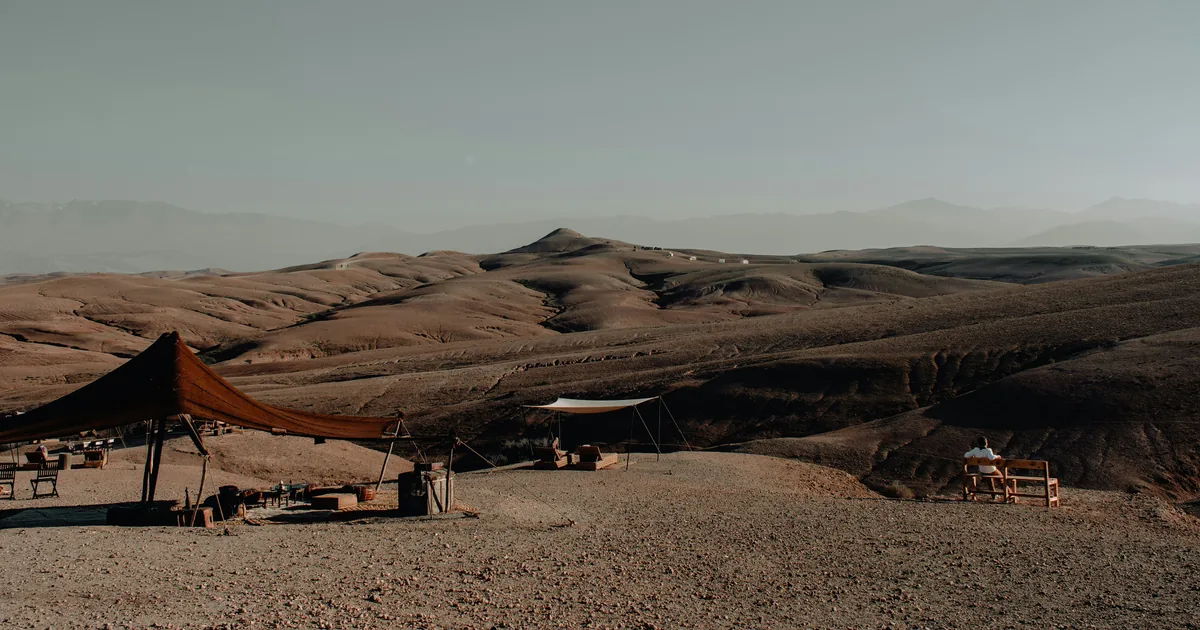
Description. A stony desert just 30 to 40 km from Marrakech, Agafay offers a quick immersion in rocky landscapes, ochre hills, camps and outdoor activities, without having to go all the way to the Sahara.
Cultural significance. Agafay is less a "historic site" than an experiential landscape: a stone desert close to Marrakech, it has become a natural extension of Marrakech stays thanks to camps, camel rides and encounters with the surrounding rural world.
Location. Approximate coordinates: 31.483960, -8.191052.
Distance / time. About 30 to 40 km by road; in practice allow 30 to 40 minutes outside heavy traffic.
Best time. Autumn, spring and mild winter. Agafay remains doable as a half-day trip the rest of the year if you avoid the hottest hours.
Hours / prices. Scenic access: not specified. Hours and prices depend on the camps, dinners, rides or activities you book.
Transport / costs. Allow about 200–270 MAD via shuttle + taxi, or 850 to 1,000 MAD for a private round-trip van depending on the number of passengers.
Suggested duration. A half day for the scenery and lunch, or one night for the sunset, dinner and starry sky.
Accessibility. Generally good by car, but variable by camp; the walking areas remain rocky and dusty.
Tip. For a simple outing from Marrakech, Agafay is often the best balance between short drive time and strong visual impact.
Ourika Valley and Setti Fatma
Description. One of the most classic outings from Marrakech: rivers, Amazigh villages, cooperatives, riverside restaurants and, higher up, Setti Fatma and its waterfalls.
Cultural significance. A serene escape into the heart of the Atlas, marked by traditional Berber villages, crafts and colorful markets; official itineraries also highlight local cooperatives and know-how.
Location. Valley: 31.343611, -7.751311. Setti Fatma: 31.225561, -7.675831.
Distance / time. Between 45 and 64 km depending on your end point; about 1 h to 1 h 15 up to Setti Fatma.
Best time. Spring and autumn first and foremost, for the most comfortable temperatures.
Hours / prices. Access to the valley: not specified. Costs come mainly from transport, optional local guides and meals.
Transport / costs. Taxi to Setti Fatma estimated at 550–700 MAD; combined bus + taxi to the valley around 300–390 MAD; private car with driver from about €75.
Suggested duration. A full day if you climb up to Setti Fatma; a long half day if you stay in the lower valley.
Accessibility. The riverbanks and restaurants are easy to reach, but the waterfall section at Setti Fatma involves steps, rocks and sometimes uneven passages.
Tip. Leave early to avoid Sunday crowds and enjoy the softer light in the valley.
Imlil and the foothills of Toubkal
Description. Imlil is the great gateway to the Marrakech mountains: an Amazigh High Atlas village with farming terraces, stone alleys and a prime base for hikes toward Toubkal.
Cultural significance. A traditional Berber village at about 1,740 m altitude, the gateway to Toubkal, the highest peak in North Africa. Its cultural interest lies in the persistence of the Amazigh mountain way of life, visible in the rammed-earth architecture, the alleys and local hospitality.
Location. Approximate coordinates: 31.126372, -7.917828.
Distance / time. About 66 km and 1 h 08 by taxi; allow 1 h 15 to 1 h 30 depending on your starting point and stops.
Best time. Spring and autumn for walking, with generally more pleasant weather.
Hours / prices. Village and general access: not specified. Some hikes, refuges or guide services have their own pricing.
Transport / costs. Direct taxi estimated at 550–700 MAD; a bus + taxi combination up to 600–800 MAD; private door-to-door transfers are also available.
Suggested duration. One day to see the village and take a short walk; two days to sleep over and enjoy a real Atlas atmosphere.
Accessibility. Moderate to low: sloping streets, uneven terrain, altitude. Staying in the village center or on a panoramic terrace is feasible without a big hike.
Tip. If you handle altitude poorly or have little mountain experience, keep Imlil as a panoramic stroll rather than a climbing base.
Lake Lalla Takerkoust
Description. A large reservoir south of Marrakech, prized for its very quick "nature break" feel: a lake, Atlas panorama, water activities and lunches with a view.
Cultural significance. An oasis of serenity formed by the dam of the same name, now a popular outing for water leisure and contemplation of the High Atlas.
Location. Approximate coordinates: 31.366944, -8.133056.
Distance / time. About 40 km south of Marrakech; in practice under an hour depending on traffic and starting point.
Best time. Spring, autumn and mild winter, when the light is beautiful and temperatures more comfortable.
Hours / prices. General access to the lake: not specified. Private beaches, restaurants, water sports or camps have their own hours and prices.
Transport / costs. Car, taxi or private transfer. If you combine the lake with Agafay, grouping the trip into a single private car is often the most logical option.
Suggested duration. A half day to lunch and enjoy the view; one day if you add water activities, a quad or a detour via the Kik plateau.
Accessibility. Good around the restaurants and roadside stops, more variable along the banks or at activities.
Tip. It's the simplest option for a "big landscape" without real logistical effort.
Amizmiz
Description. A small Atlas town prized for its rural atmosphere, craft stops and potential for cultural excursions that feel less standardized than Ourika.
Cultural significance. The link between Amizmiz, the Tameslouht road, women's cooperatives and Amazigh craft heritage — argan oil, honey, carpet weaving and the local economy.
Location. Approximate coordinates: 31.210000, -8.250000.
Distance / time. About 59 km and 55 minutes of road travel.
Best time. Spring and autumn, when the light flatters the foothill landscapes and the heat stays comfortable.
Hours / prices. Town center and surroundings: not specified.
Transport / costs. Taxi estimated between 200 and 650 MAD depending on negotiation, vehicle and starting point. Confirm the fare before getting in.
Suggested duration. A long half day for a cooperative and lunch; one day combining the road, crafts and countryside.
Accessibility. Good in town; more variable as soon as you leave the main road for rural stops.
Tip. Amizmiz works very well for a quieter outing, less of a "must-see," but more rooted in everyday rural life.
Essaouira
Description. The great ocean escape from Marrakech: a listed medina, ramparts, beaches, a fishing port, galleries and a gentler atmosphere than the Red City.
Cultural significance. Essaouira's medina has been a UNESCO World Heritage Site since 2001; a place where maritime heritage, crafts, art and festivals meet, in a city long known as Mogador.
Location. Approximate coordinates: 31.513023, -9.768696.
Distance / time. 191 km from Marrakech; about 2 h 24 by car and 3 h by bus.
Best time. The Atlantic coast is pleasant year-round; spring and autumn are ideal for walking, summer for the seaside vibe and wind sports.
Hours / prices. Town, beach and medina: not specified; many spaces are freely accessible. Hours depend on the monuments, museums, workshops or ramparts you visit.
Transport / costs. Bus at 80–130 MAD for 3 h; a Supratours ticket observed at 140 MAD with about 7 departures per day; CTM from 205 MAD depending on class and date.
Suggested duration. One day minimum, but one night is clearly more comfortable.
Accessibility. Fairly good for a non-mountain Moroccan destination, though the medina's cobblestones can bother some visitors.
Tip. If you only have one day, focus on medina + ramparts + port + a fish lunch, without trying to do everything.
Ouzoud Waterfalls
Description. One of the most beautiful big-nature spots accessible from Marrakech: a spectacular fall of more than 110 m, laid-out trails, colorful boats, old mills and the presence of macaques.
Cultural significance. Grain mills still tied to the torrent's water, the old village of Tanghmelt, and a site of biological and ecological interest marked by its travertine geology and biodiversity.
Location. Approximate coordinates: 32.015278, -6.718889.
Distance / time. About 157 to 161 km by road, for 2 h 40 to 2 h 44 by car and about 3 h without a car.
Best time. Spring and autumn; the walk remains doable more widely, but temperatures and light are better outside peak heat.
Hours / prices. General access: not specified.
Transport / costs. Car estimated at 220–340 MAD; without a car, bus + taxi around 1,000–1,300 MAD. Day excursions are sold from about €15 to €17 per person.
Suggested duration. A full day.
Accessibility. Moderate to low: many steps and slopes to reach the bottom of the falls, though some high viewpoints are more accessible.
Tip. Go down slowly, bring water and good shoes; the climb back up is longer than it looks.
Telouet Kasbah
Description. A strong heritage stop in the High Atlas, often underrated in favor of Aït Ben Haddou, even though its Glaoua kasbah tells another side of power and the trans-Atlas caravans.
Cultural significance. The former seat of the Glaoua, on the old caravan route to the south. Construction of the kasbah began in the 19th century, and the site became a symbol of the El Glaoui family's power before its gradual abandonment after independence.
Location. Approximate coordinates: 31.288151, -7.236820.
Distance / time. About 129 km by road between Marrakech and the kasbah, for around 3 h 30 to 3 h 45.
Best time. Spring and autumn, like most High Atlas and southern circuits.
Hours / prices. Not specified officially. Some sources mention a caretaker and modest entry fees; better to confirm on site.
Transport / costs. Trip without a car around 210–280 MAD. In practice, this visit is often paired with a private driver or a loop including Aït Ben Haddou.
Suggested duration. 2 to 3 hours on site, or one day combining Telouet and Aït Ben Haddou.
Accessibility. Moderate to low: steps, uneven floors, ruined sections and cautious pedestrian movement.
Tip. Telouet makes the most sense if you love raw, less-restored, more atmospheric heritage Morocco.
Aït Ben Haddou
Description. The quintessential icon of earthen heritage in the Moroccan south: a spectacular, photogenic, world-famous ksar.
Cultural significance. The Ksar of Aït Ben Haddou has been UNESCO-listed since 1987, a striking example of southern Moroccan architecture; a fortified village on the old caravan route between the Sahara and Marrakech.
Location. Approximate coordinates: 31.050000, -7.133333.
Distance / time. About 171 to 173 km by road, with 2 h 57 by car and 3 h 50 to 4 h without a car depending on the bus + taxi combination.
Best time. Spring and autumn, the most pleasant for southern landscapes and kasbah / desert circuits.
Hours / prices. Not specified officially and stably; some ancillary services or guides may charge.
Transport / costs. About 190–270 MAD for the cheapest bus option and 240–360 MAD in estimated driving cost for the car.
Suggested duration. 2 to 4 hours on site; a long day from Marrakech; ideally one night if you add Telouet or Ouarzazate.
Accessibility. Moderate: earthen alleys, steps, uneven passages, access varying with the season and the river level.
Tip. Don't settle for the frontal photo; climb a little to understand the ksar's overall structure.
Ouarzazate
Description. The logical gateway to the deep south from Marrakech: kasbahs, cinema, departures toward valleys and desert, and a "plateau-town" atmosphere very different from the coast or the green Atlas.
Cultural significance. Nicknamed the "Hollywood of Africa," a starting point for excursions to the south and part of the UNESCO Creative Cities network in the Film category; the Atlas Studios, built in 1983, strongly boosted the region's tourism profile.
Location. Approximate coordinates: 30.916667, -6.916667.
Distance / time. About 194 km and 3 h 49 between Marrakech and the Ouarzazate area; direct bus in about 4 h 12.
Best time. Spring and autumn, the most suited to southern roads and arid landscapes.
Hours / prices. Town: not specified. For the Atlas Studios, visits are advertised daily from 08:00 to 18:30, at 80 MAD for adults and 50 MAD for children.
Transport / costs. Direct bus from 100 MAD, or estimated driving cost of 280–420 MAD. A car mainly lets you better combine Aït Ben Haddou and possibly Telouet.
Suggested duration. A long day at the bare minimum; two days are clearly more rewarding.
Accessibility. Good in town and at the major urban sites; more variable at the kasbahs, studios and high points.
Tip. If you go all the way to Ouarzazate, avoid making it a rushed round trip; the town gets more interesting when you sleep there.
Itineraries
Gentle half day — Agafay
- 08:00 Optional bag drop via Blastey luggage storage in Marrakech.
- 08:30 Departure by taxi or private transfer toward Agafay.
- 09:10 Arrival, tea, panoramic photo stop.
- 10:00 Short walk, coffee break or a light experience.
- 12:00 Lunch with a view.
- 14:00 Return to Marrakech.
Why it works. A short outing, strong landscapes, limited fatigue, ideal before a train or a late flight. Agafay remains the best "low logistics / high change of scenery" excursion.
Full nature day — Ourika and Setti Fatma
- 08:00 Departure from Marrakech by taxi, private driver or minibus.
- 09:15 Arrival in the valley; coffee / cooperative stop.
- 10:30 Climb toward Setti Fatma.
- 11:00–13:00 Gentle walk toward the waterfalls or a riverside stroll depending on your level.
- 13:30 Lunch by the river.
- 15:00 Free time for photos, crafts, rest.
- 17:00 Return to Marrakech.
- 18:15–18:30 Arrival.
Recommended transport. Taxi or private driver to stay flexible; a shared excursion for a lower cost.
Three-day trip
Day one — Proximity and quick landscapes
- 08:30 Marrakech → Lalla Takerkoust by car / taxi.
- 09:30–12:00 Lake loop, coffee, photo stops.
- 12:15 Lunch with a view.
- 14:00 Drive to Agafay.
- 14:30–17:30 Gentle walk, desert break, sunset.
- 18:30 Return to Marrakech or overnight at an Agafay camp.
Day two — Living Atlas
- 08:00 Marrakech → Imlil by car / taxi.
- 09:15–12:30 Explore the village and an easy walk.
- 13:00 Local lunch.
- 14:30 Direct return to Marrakech, or a short extension toward Asni / the valley.
- 17:30 Return to Marrakech.
Day three — Grand heritage
- 07:00 Very early departure from Marrakech.
- 10:30 Visit Telouet.
- 12:30 Drive to Aït Ben Haddou.
- 13:30–16:30 Lunch + visit of the ksar.
- 18:30–19:30 Return toward Marrakech, or overnight in Ouarzazate / Aït Ben Haddou to ease the pace.
Times are kept deliberately flexible: photo stops and tea breaks change the real rhythm a lot.
FAQ
What's the best excursion if I only have half a day?
Agafay is generally the best choice: very close to Marrakech, visually strong, and compatible with a simple round trip during the day or even in the late afternoon. Lalla Takerkoust comes just behind for a more contemplative profile.
Which outing for the mountains without a long hike?
Ourika and Lalla Takerkoust suit you better than Imlil if you want little effort. Imlil becomes the best choice as soon as you're after more alpine atmosphere and walking.
Is Essaouira worth the day from Marrakech?
Yes, but ideally with an overnight stay. The drive is reasonable, and the city combines a listed medina, ocean, port and gastronomy. As a single-day round trip, you have to be very disciplined about the program.
What's the best heritage duo in the High Atlas and the south?
Telouet + Aït Ben Haddou is the most coherent pairing if you love earthen architecture and the history of the old caravan routes. Ouarzazate complements this tandem perfectly if you have more time.
Is Ouzoud suitable for children or less athletic visitors?
Yes for the general view and upper edges; much less so for the full descent to the foot of the falls, since the site has many steps and uneven terrain.
Which excursion if I want to avoid the "big classics"?
Amizmiz is an excellent alternative, especially if you're after crafts, countryside and a quieter pace. Tameslouht can serve as a very close bonus along the way.
What's the best time of year to visit around Marrakech?
For most inland and southern excursions, spring and autumn remain the most balanced seasons. Coasts like Essaouira are pleasant year-round, while the mountainous or desert interior mainly calls for avoiding heat extremes.
How do I organize these excursions when I have luggage?
The simplest is to drop your things before you set off with Blastey luggage storage in Marrakech, then travel light all day. To dig deeper into your stay, also read the guide on what to do in Marrakech after hotel checkout.